Spring in Golgotha: A Corona Catechism in Three Parts

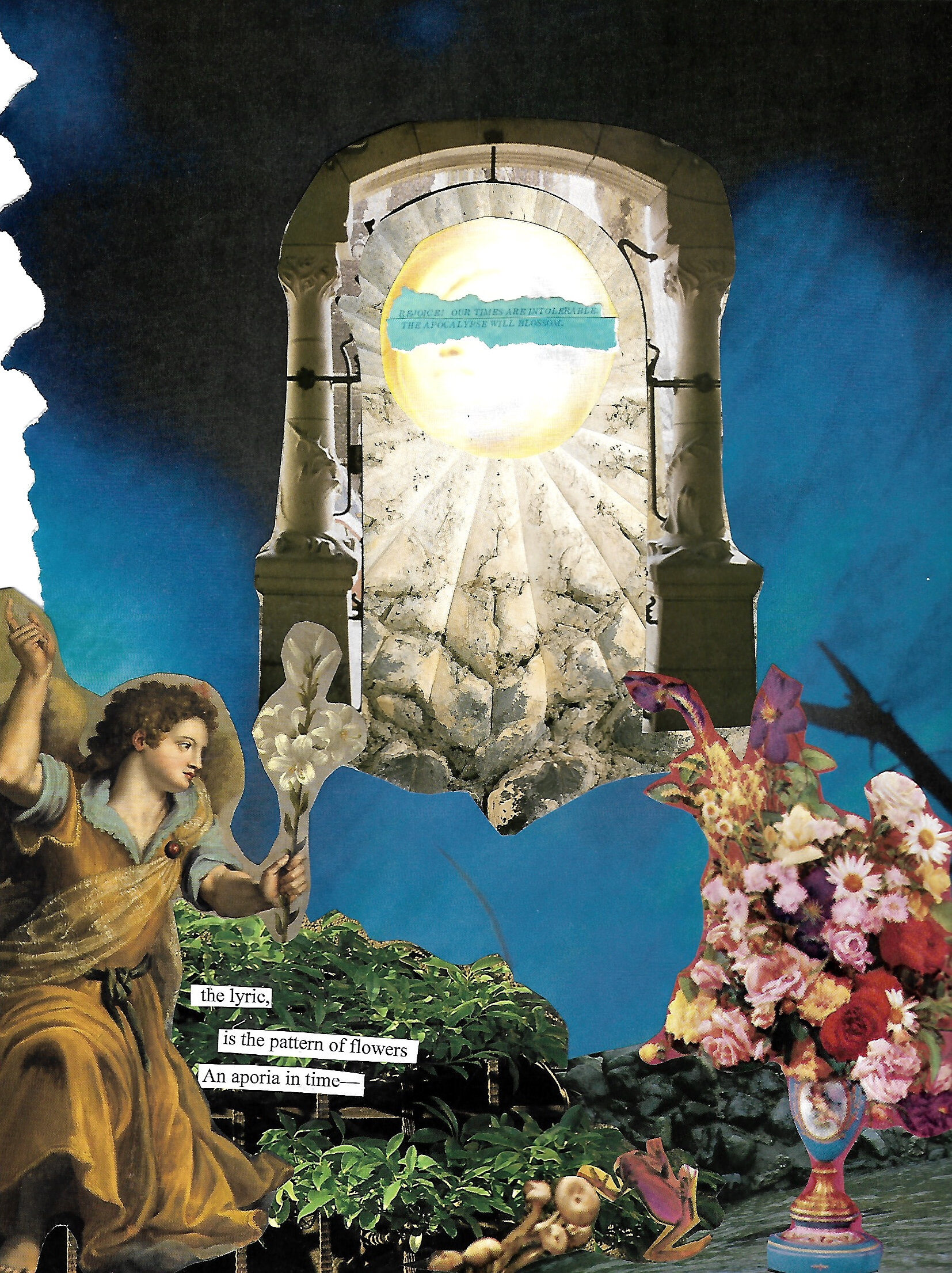
Collage by Rob Jackson
An Ecclesiastic Refrain
I was raised a Catholic and though I haven’t practiced in over a decade, the stories and rituals of Easter still resonate with me. Of course, there are the opportunities to gather with family, the white and gold adornments of the clergy, the painted eggs and tulips. There is the promise of redemption and rebirth and there are the songs that carry those truths. But what I remember most is the solemnity of Good Friday and the brute fact that people were killed and tortured at the hands of the law and because the sovereignty of masters was challenged. There is the cruelty of cops rolling dice for the garments of a dead man in the place of skulls, and there is the mocking dismissal of a life of mutual aid and compassion—a life that prefigured the promise of a world to come where the tyranny of those masters would be torn asunder.
For those of us in the Global North, the Easter story also carries particular resonances with the inauguration of spring. The light extends into the evening, the nuthatches, sparrows, starlings, and squirrels sing in chorus. The herons and ducks return to the thawing river. Trees bud and the wind is warm. Grafted onto the rhythms of the Earth, the Easter story takes on an archetypal significance, helping us make sense of the world. Archetypes provide a unifying structure to the fragmentary and painful experiences of our lives and offer the promise of balance and cyclicality. They harmonize time and space in an elegant poetics capacious enough to hold the granularity of our personal circumstances while also unfolding toward the mysteries of our more broadly human and spirited experiences. Winters do end. Death does give way to life. Hope springs.
Amidst the devastation of COVID-19, this pastoral refrain of growth provides comfort for those of us seeking stability in uncertain times. Seeing pictures from my friends in Vancouver, I want to smell the cherry blossoms in the air. I also want to believe that this crisis is bringing out the best in us: conversations about solidarity and mutual aid are mainstreaming; neighbours are taking care of each other; rent strikes are being organized; people are realizing in embodied and profound ways the terror of a life waged under capital. New habits are being formed and old wisdoms are being engaged. And yet something in the hope and promise of a restored equilibrium feels eerie to me. I don’t have faith that we will carry many lessons forward from this crisis and, if we do, what will they be and whom will they serve?
These days I don’t believe in divinity any more than I believe in the just rule of Caesars. And while I do believe in the wisdom of the Earth and its cycles, I think it’s hubristic to think that the archetypal narratives I recognize in their movements are at all accurate, yet alone complete. Of course, there are communities who hold these stories with local and ancestral knowledge, but those are not my stories. In amiskwaciy, where I live, I have learned from nêhiyaw Elders and knowledge keepers to watch for the geese in March and listen for the frog songs in April, though it will take many lifetimes of unlearning the arrogance of settler-colonialism to draw more than a tangential understanding from these movements.
And so, returning to a story that does live in me in deep and ancestral ways, I will say that in many ways the Easter story echoes the ecclesiastic wisdom of the Old Testament: “to everything there is a season.”
April Showers bring May flowers. All things must pass. Bad shit happens, but how would we know the good times were good if it didn’t? Have faith. The sun also rises. There will be growth in spring.
But in the absence of a belief in divine providence, or a natural order, or the benevolence (let alone competence) of the state, what force brings peace after wartime measures, restores health after times of sickness, rebuilds after breakdown?
From where I’m standing, there seems to be one answer that holds up to scrutiny better than all the others. The force that will survive this crisis and equalize us back into some kind of normalcy will not be natural or divine. It will be historical. It will be the movement of the capitalist world system that will tell us when things are back to normal, demand that a new beginning has come, and it will be in the incessant need of that system to accumulate that we will find signs of spring. I don’t write this with any happiness in my heart; capital’s commitment to growth has ravaged the Earth and created a world of full of immiseration. And yet we know that capital breeds through crisis, finding new ways to reproduce itself at larger and larger scales. As these scales extend, colonizing more territories and futures than we can map, the reality that capital and its deputies (states, corporations, police, politicians, and landlords) care less and less about human life than they did yesterday is a stark reminder that spring is coming, and it is not pastoral. It is coming after the wilting autumn and the deadly winter. It is necrophiliac and cruel.
Herein lies the eeriness of return. The seasonal wisdom of the ecclesiastic refrain finds its double in the common sensical chorus of liberals: We’ve seen this before…the economy will recover! Remember the 80s? Jobs will come back. People will always need oil. This refrain reverberates through quotidian conversations I have with my neighbours as well as the speeches of political pundits and the thin analyses of mainstream media. It is a refrain we structure our lives around. Or rather, it is a refrain that structures our lives for us.
The story that markets self-regulate and that we can always expect an economic upturn after a period of recession is the archetypal story of modernity. Its hero is capital and we are extras. But, most of all, it is a lie. The invisible hand might be wearing sanitary gloves, but it doesn’t care for us and it sure as hell won’t save us.
In a recent short essay, Joshua Clover identifies the quick emergence of genres of the quarantine. It is not hard to see what he means. It feels like there have never been more webinars, think pieces, academic analyses, personal essays, or front-line dispatches about the same topic worldwide. In some ways I am grateful for these pieces because they help me understand the international and global dynamics that COVID-19 has set in motion.
Yet I am cautious against proliferating attempts to mine some sort of optimism from this pandemic because I fear that, in these attempts to make meaning of terror, we might end up naturalizing the system that caused it in the first place: capitalism. Narratives tend to naturalize, after all; stories are a way we metabolize the world. In my own attempts to think through this moment, I find myself turning away from the genres of quarantine that celebrate the bravery of service workers and care workers, the sacrifices of the isolated, and the possibility of a better world to come after we can all gather in the streets again. I’m also not interested in a direct critique of these stories. As Jackson Browne sings in “The Rebel Jesus,” “I’ve no wish to come between / this day and your enjoyment / in this world of hardship and earthly toil / we’ve need for anything that frees us.”
Instead, I find myself returning to the first movement of the Easter story, before the redemptive moment: the place of skulls. I wonder what I might learn sitting with the historical reality of cruelty and betrayal. Before revelling in the stigmatic miracle—or the miracle cure—what will our analyses and our bodies teach us about grief, normalcy, and the cruel optimism of faith in a moment of crisis?
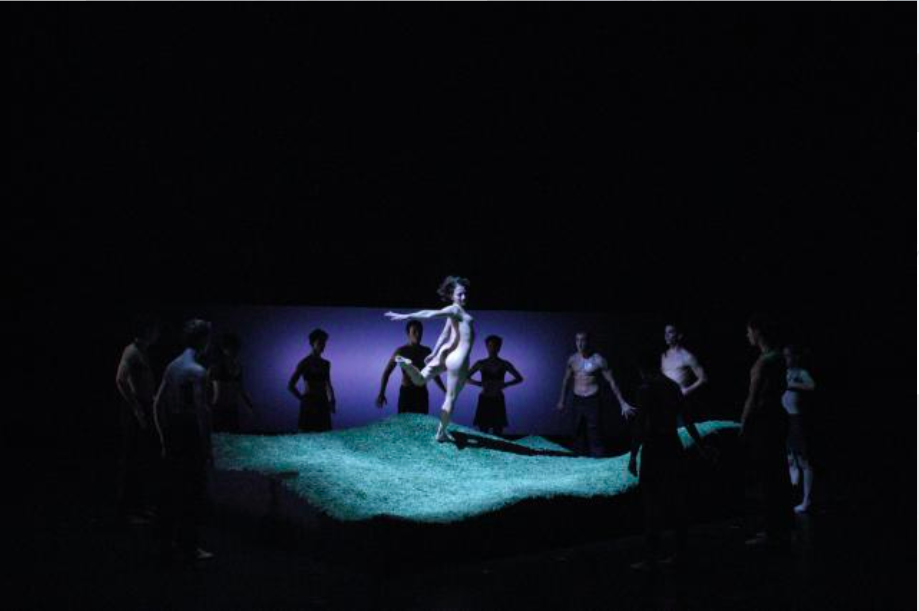
Photo credit: Richard Termine, Scene from the Ballet Preljocaj production "Rite of Spring" during BAM Next Wave Festival, 2002
The Rites of Spring
I am drawn to narratives and archetypes not because I think stories are all we are. I am drawn to them because stories tell us something about the social relations in which we find ourselves entangled. The former tendency might lead us to believe that if we just get the story right, that if we listen closely enough or study deeply enough or repeat the story exactly as we want it to be, change will come. But the latter tendency might lead us to understand that while the impasses we face in the wake of pandemic and crisis and apocalypse do require different stories, those stories must be animated by collective movements to transform the way our social relations are organized.
What’s important to me in this distinction is the torsion between identity and location; subject and relation; agency and emplotment within a social totality. This is not to say that personal stories, identities, and expressions do not matter—nothing could be further from the truth!—but it is to say that our stories matter precisely because they are set and circulate historically. This relationship between our subjective experience of structures that objectify us is the squeaky dialectical gear at the core of the struggle called history. How different stories are sedimented and adapted, amplified and muted, tells us about how history is narrativized and how its social orders are naturalized and maintained. What’s at stake here is how we understand our relation to each other, to the Earth, to our bodies, and to our imaginative limits. This is the political kernel of interpretation.
Tracking the harmonics of stories is important because it helps us understand how some of these stories appear to presuppose us. As stories about who we value and why are normalized, they seem to be as inevitable and natural and universal as a spring thaw.
Gender. Race. Class. / The Body. The Prison. The Economy.
These are all genres of domination. They cluster our experiences of the world, becoming filters for our visions of what is possible and categories for sorting out what is not. Like all categories, these genres serve a purpose: they sort and simplify the complexity of our relations, turning nuanced historical processes of socialization into adaptable and digestible stories that carry their own narrative arcs, recognizable conflicts, and horizons of closure. To be clear, these genres are neither natural nor inevitable, but in the topsy-turvy world of capital they appear to be.
In the context of COVID-19, I watch as fear and scarcity costume old stories of wartime measures, of total state authority, and protectionism in the cloak of safety and civic duty. Snitchlines open up so that each of us can participate in that great modern drama of policing. The furloughs and meagre reliefs offered to us by our bosses and our politicians by way of the CERB and CARES Act, for example, repeat the martyrologic tale of sacrifice that is baked into the Easter story. In short, we can each become minor heroes in the grand narrative of return. But, it is not the soul of the people that is being saved this time, or the Kingdom of Heaven to which we will be welcomed back. Capital is our sovereign now and what our sacrifices will return us to, if we’re lucky, is that necessary cruelty of the wage.
On April 17th, as the warmth of spring came to Edmonton, Donald Trump called for things to start returning to normal: “We’re starting our life again. We’re starting rejuvenation of our economy again in a safe and structured and very responsible fashion.” His announcement was met with a swell of standoffs between white nationalists and nurses in front of hospitals across the US. Authorized by the presidential call, an unwavering populist commitment to the cold comforts of individual liberty came in direct conflict with the politics of care. People would rather be able to get their haircut and return to their shitty jobs than live in solidarity with frontline workers, the vulnerably ill, the disabled, and the elderly. Trump’s emphasis on rebirth and rejuvenation returns us to the archetypal stories of spring, though this time with a dark slant that calls to mind Igor Stravinsky’s famously dissonant composition The Rite of Spring more than it does the biblical harmony of Easter.
Stravinsky’s masterpiece tells the story of an ancient seasonal ritual of renewal that marks the shift from the harshness of winter to the blooming possibilities of spring. But nothing good comes cheap. In Stravinsky’s avant-garde reworking of Russian folk traditions, a woman is required to dance herself to death so that her community can enjoy the fruition and abundance of a new season. Unlike the Easter story, Stravinsky’s archetypal narrative brings the gendered dynamic of sacrifice into clear view. The stakes of social reproduction are put into stark relief in this era of social isolation. Tithi Bhattacharya and others remind us that our stories about whose lives should be protected and valued are entwined with the labour we are conscripted to perform for capital. This labour is intrinsically striated by patriarchy, white supremacy, and the violence of the settler-colonial state. With a global pandemic ravaging the economy, the lived realities of this striation surface in gritty detail.
In the spheres of production directly mediated by the market, knowledge workers get to work from home; warehouse and garment workers are either laid off or continue to toil in extremely precarious conditions; grocery store workers, nurses, health aides, and other essential workers occupy the frontlines with the scant protections of face shields and rubber gloves, often while being denied rent protections, a living wage, or—in the United States, most notably —medical care. In the spheres of life indirectly mediated by the relations of production (the home, for example) domestic violence is on the rise and the relentless burdens of childcare are intensified by the move to home-schooling.
COVID-19 has often been called a democratic virus. Maybe this is truer than we would like to admit. COVID-19 surfaces the structural brutalities, social contradictions and internal fissures of liberal democracy. As Bhattacharya writes:
Nearly 90 percent of home healthcare workers and nurses’ aides in the United States are women. More than 50 percent of them are women of color. I am not sure—nobody is—how many of them are undocumented. They are doubly vulnerable, to both job losses and ICE raids. On average, they earn around $10 an hour, and they mostly have no paid sick time or health insurance. These are the women whose work is sustaining so many of the care facilities of our country.
In this context, the notion that these racialized and feminized workers are heroes reveals the sharp double-edges of life under capitalism. On one hand, the work performed by women of colour keeps us alive. It is essential in the most real sense because it provides life-sustaining activities. It should be immediately recognized by higher wages and job security and centred in global labour struggles. On the other hand, the designation of these duties as “essential services” naturalizes a system that sacrifices people’s health and safety so that others can eat, stay alive, work, and enjoy the quiet cherry blossoms of spring from relative comfort. As one nurse in Brooklyn writes: “Please don’t call me a hero. I am being martyred against my will.”
In Ballet Preljocaj’s performance of The Rite of Spring, Stravinsky’s tale is staged as a struggle between genders. Movements of sexual violence and struggle contort the dancers’ bodies in a choreography of exhaustion. The sacrificial, frantic, terrified, and tired movements of the women’s bodies in Preljocaj’s work is mirrored in the affect that radiates in the viral image of the nurse’s protest. By the end of the ballet, a single woman dances naked in the centre of the stage. She is surrounded by silhouettes of a lustful and hungry community. Before the music dies and the stage fades to black, we see her body prostrate on green hills. Unfurling from a fetal position she stretches her arms out to her sides in the form of a cross. She is dead and alone. The green hills are surrounded by an absent darkness. We are in Golgotha again.
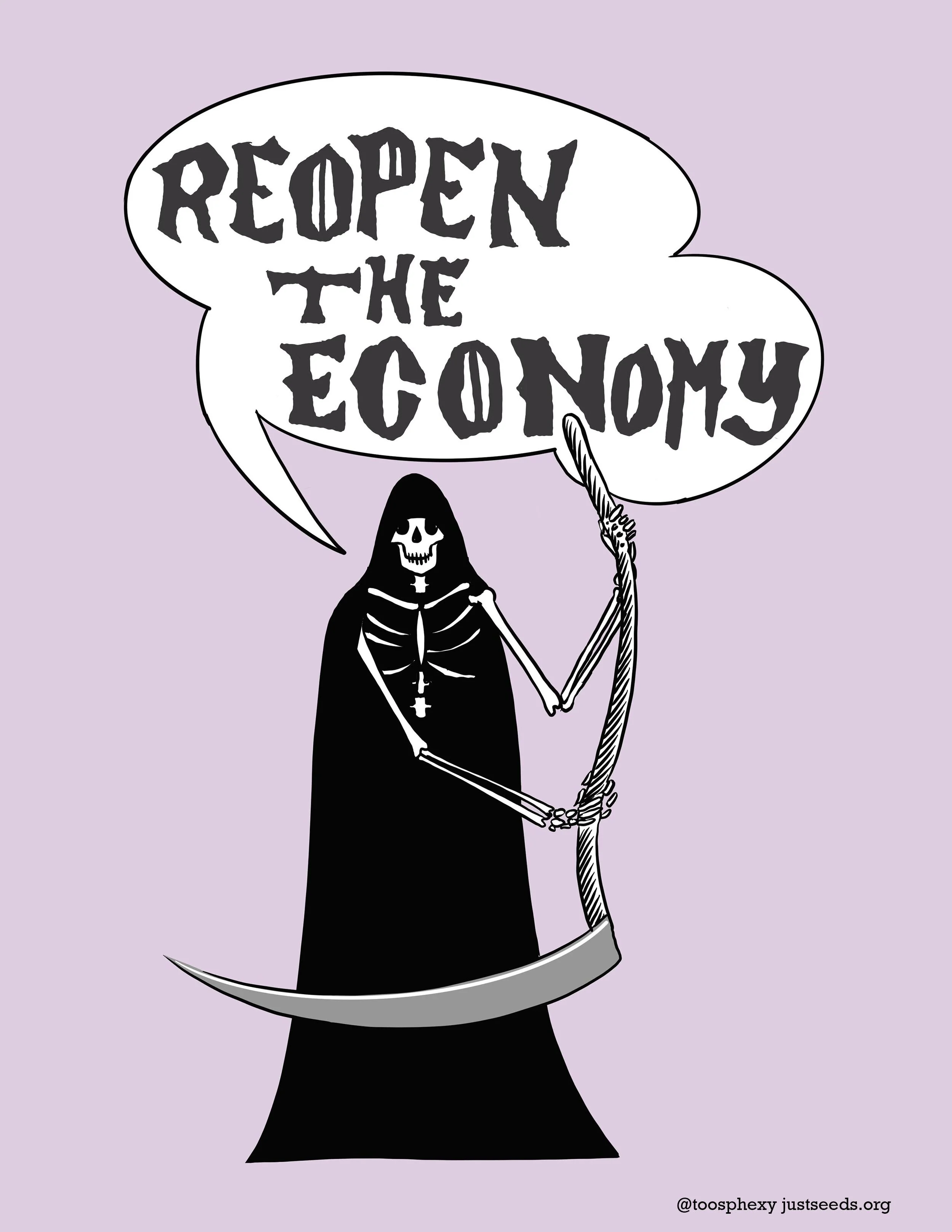
Roger Peet, “Reopen the Economy”
A Terminal Spring
As should now be clear, I’m a Marxist. I see history as the unfolding of various struggles against a totalizing system of exploitation and pain that structures every prominent social relation of my world, and this includes COVID-19. This doesn’t mean that I think the only story available to us is the victorious arc of capital against human life, but it does mean that I think this narrative arc is one that we must tarry with in serious ways. My suspicion of the harmony promised in the archetypal promise of spring’s new beginnings is that these promises naturalize human misery, suggesting that there is always balance in a better world to come. For me, this is a utopian trick that resonates more with The Sermon on the Mount than it does with The Passion. It serves our Earthly masters.
The argument of this essay is not that spring won’t come or that there is no hope to be found amidst the perversions of the present. As I’ve written this essay, spring has come to Edmonton. The snow has melted, the neighbourhood kids have started riding their scooters and rollerblades, and my spirits have been lifted by the warmth and the light. What I’ve hoped to offer in this piece is a way of understanding how the ecclesiastic refrains of spring risk naturalizing the COVID pandemic, as well as the ensuing political and ideological crises we are witnessing. We should read these archetypal narratives slantwise in order to ask the crucial question of what’s lost and what gets carried forward when narratives of crisis are normalized through an archetypal language of seasonal transition. What myths root our faiths and constrain our visions of what type of transitions are possible?
COVID-19 has made it morbidly clear that the so-called stability of the long twentieth century will not survive the pending global catastrophes. The social fabric of liberal democracy is fraying at the seams and quick-stitch attempts to hold it together are decidedly alarming. The World Food Program predicts that 265 million people will face severe famine as COVID looms. Trump is closing the US borders, ordering a 60-day moratorium on immigration. The South African military is enforcing lockdown with rubber bullets. In Alberta, Jason Kenney is projecting 25% unemployment as the UCP rolls out the province’s largest layoff in history. Construction of the CGL pipeline persists in the un-surrendered Indigenous territories of northern British Columbia. In New York, burials of the anonymous and unclaimed at Hart Island have increased fivefold since the start of the pandemic. Across Canada the police have been given expanded authority: ticketing people experiencing homelessness in Hamilton; doubling down on street checks in Edmonton; arresting housing rights activists in Vancouver. In Winnipeg, cops killed three Indigenous people in the span of ten days.
This litany outlines that narratives of domination are bleeding into each other. The nomenclature we once gave, however foolishly, to distinct spheres of the political, economic, social, and environmental is no longer effective. We can no longer hope for a genial pact between climate justice and petro-capitalism. We can no longer believe that gender-based violence can be meaningfully distinguished from crises of unemployment. We can no longer pretend that electoral politics are autonomous from the imbrications of white supremacy and wealth inequality that structure our lives. Which one of these narratives gave way first is not a particularly interesting question to me right now: the point is that the totality woven of these superficially distinct threads is entropic. As the opening movement of June Jordan’s 1977 poem “On the Loss of Energy (And Other Things)” reads:
no more the chicken and the egg come
one of them
before the other
both
be fadin (steady)
from the supersafeway/a&p/giant
circus
uh-huh
the pilgrim cornucopia
it ain’ a pot to pee in
much
(these days)
gas is gone
and alka seltza runnin gas
a close race
outasight/you
name it
toilet paper
halfway honest politicians
there’s a shortage
folks/please
step right up)
a crisis
(come in closer)
A International Disaster
Definitely Takin Place
Jordan’s poem takes aim at the apathy behind public performances of cooperation during the deadly contractions of racial capitalism. Behind the tautological bickering of the chicken in the egg is the hard materiality of structural abandonment and manufactured scarcity. How to pay for food? How to pay for rent? How to pay for utilities? Though directly connected to worker’s struggles for higher wages, these questions circulate firmly within the domain of social reproduction.
As grocery stores become monuments to social crises, gas prices plummet, and toilet paper becomes the objet petit a of COVID-19, it’s hard for me not to laugh at the prophetic, sardonic wit with which Jordan articulates the rot of the settler-colonial dream of (autumnal) cornucopia. What gives Jordan’s poem its critical incision is that the whole narrative of decay is, in a terrible way, a farce. Crisis isn’t new and the inequalities it surfaces aren’t either; the pilgrim’s cornucopia has always been a disaster for the descendants of the enslaved, Indigenous peoples, and colonized peoples worldwide. In the shadow puppetry of Empire, Jordan sees how crisis has come to shape life in the long downturn, and how it’s been peddled by merchants of despair, distracting us from the real, intimate movements of capital and the immiseration these movements cause.
Every good theory of crisis has to account for how the tectonic movements of abstract social systems reverberate in the concrete experience of our lives. Jordan herself wrote in 1981, “my life seems to be an increasing revelation of the intimate face of universal struggle.” Of course, the face of universal struggle has many expressions. The job of cultural workers is to attend to the personality of struggle that might be gleaned from these expressions, knowing that the character of capital is always more than the sum of its parts. As Marx wrote in 1857, “The concrete is concrete because it is the concentration of many determinations, hence the unity of the diverse.” By attending to the diversity of experiences under capital we might be able to understand totality more robustly. In the case of COVID-19 this isn’t hard: for many people in the world even our most intimate patterns are becoming directly constrained by the consequences of globalization and the world economic system.
Today I was out for a walk with my dog. We could both smell leaves and shit and other organic material decomposing. I was reminded that the smell I associate most with spring isn’t the sweetness of blossoms or buds, but of the richness of decay. I’ll concede that this might be a point of interpretation but, hey, that’s mainly what this article is about. In a recent article in Spectre, Zachary Levenson reads COVID-19 through Antonio Gramsci’s theory of organic crisis. For Gramsci, Levenson argues, organic crises are ones characterized by “the confluence of crises in nearly every sphere” of life. As the bourgeois social order shows signs of decomposition in the terminal spring of COVID-19, it becomes hard to distinguish one matter of concern from the other; as the leaf and the pine cone and the scat decompose they lose their distinct essence in the soil. What grows out of this soil is an open question and we should approach it ambivalently.
Since the 2008 economic crisis, the theory of secular stagnation has been resuscitated in many analyses of market growth. In short, secular stagnation challenges conventional wisdom that the invisible hand of the market will restore growth and equilibrium after economic recession. By tracking birth and mortality rates, plateauing wages, increased automation, and the correlating persistence of un/der/employment, economists from the right and left alike tarry with what Annie McClanahan names the harsh truth that instead of an engine of regrowth and rejuvenation, “capital’s dynamic circuit has become instead the site of impasse, stall, and terminal stagnation.” The cost of living rises, the generation of wealth takes place in the increasingly arid territories of financialization, and work becomes ever more precariously organized. In tandem, the death count of COVID-19 rises exponentially. The resonance of McClanahan’s projection is inflected with a heightened terror: the stakes are the stakes of survival.
In the face of this terminal, organic impasse, I think we need to stay with the grief that comes as we realize that we will not be returning to the normal lives we lived in pre-pandemic times. We should honour this grief in whatever ways we need to, validate its rage, and tend its blossoming into care. Rather than finding comfort in the natural cycles of the season, we might remember that this spring is terminal. Nothing about this organic moment of crisis is natural. COVID-19 has made spring uncanny. Rather than deferring our action for the celebrations to come when we have been released from isolation, we should recognize that we are alive in the place of skulls, and we have an opportunity to tell Caesar that the crucifixions and sacrifices will not continue on our watch.
Rob Jackson is an educator and researcher living and working in Treaty 6 territory. He is a member of the Writing Revolution in Place Collective, facilitator of the Open Secret Research Spore, and curator of the Louise Michel Library Project. Rob is interested in what experimental poetics can teach us about social theories of liberation and the collective movements that actualize and inform those traditions of thought. He is also a PhD candidate in English at the University of Alberta.